
Certified Loss Prevention Associate (CLPA™) Certification

Certified Loss Prevention Associate (CLPA™) Certification
Foundation for Modern Loss Prevention Practice
The Certified Loss Prevention Associate certification is designed to build a strong foundation for individuals entering the loss prevention profession. It provides essential knowledge of core concepts, common risks, basic investigative practices, and the operational principles that guide modern loss prevention work. This entry-level credential prepares participants to perform effectively in diverse support roles, contribute to shrinkage reduction efforts, and grow confidently toward more advanced professional responsibilities.
The CLPA™ certification is a foundational professional credential that expands on entry-level knowledge and introduces structured loss prevention practices. It equips candidates with a deeper understanding of operational risk, theft patterns, fraud indicators, and the practical application of security procedures.
The program bridges theoretical concepts with operational execution, enabling candidates to contribute meaningfully to loss reduction initiatives within organizations.
Entry Requirements

CLPA Program of Studies:
- Module 1: Introduction to Loss Prevention Processes and Systems
- Module 2: Understanding Retail Operations
- Module 3: Basics of Security Technologies
- Module 4: Principles of Surveillance and Monitoring
- Module 5: Customer Service and Conflict Resolution
- Module 6: Report Writing and Documentation Procedures
- Module 7: Legal and Ethical Considerations in Loss Prevention
- Module 8: Emergency Response Procedures
- Module 9: Introduction to Fraud Prevention
- Module 10: Risk Assessment and Management
Entry Requirements
- Successful completion of the Basic Professional Certificate in Loss Prevention or equivalent foundational training, or relevant work experience
- Minimum of a high school diploma or equivalent
- Licenced Security Guards
- Licenced Private Investigators
- Basic understanding of security, retail operations, or loss prevention principles
- Ability to read, interpret, and apply instructional materials and case scenarios
- Commitment to professional development within the loss prevention or corporate security field
Benefits of the CLPA Certification
- Establishes professional credibility in the loss prevention field
- Strengthens operational competence in retail and logistics environments
- Enhances understanding of fraud prevention and risk management
- Prepares candidates for supervisory and operational roles
- Provides a clear pathway to CLPO™ certification
Learning Outcome
Candidates will be able to:
- Analyze operational risks in retail and distribution environments
- Apply surveillance and monitoring techniques effectively
- Identify fraud and theft patterns
- Prepare structured security/loss prevention incident reports and documentation
- Understand compliance requirements and ethical standards
- Contribute to organizational loss prevention strategies
The CLPA Certification Is For?
- Entry-level professionals seeking career advancement in loss prevention
- Individuals with basic security experience
- Retail and warehouse staff transitioning into loss prevention roles
Job Opportunities
- Loss Prevention Associate (with valid government licence, if applicable)
- Retail Loss Prevention Officer
- Inventory Control Assistant
- Security Officer in Commercial Settings (with valid government licence, if applicable)
- Warehouse Loss Prevention Staff
Detailed Program of Studies for the CLPA Certification
Module 1: Introduction to Loss Prevention Processes
This module provides a solid foundation for understanding how organizations safeguard people, property, and profitability. It examines common sources of loss, essential prevention strategies, and the structured processes that support effective protection. Learners gain a clear appreciation of how loss prevention strengthens operational resilience across different business environments.
- Introduction to Loss Operations and Loss Prevention Strategies
- Introduction to Loss Prevention Processes and Practices
- Fundamentals of Loss Prevention and Organizational Objectives
- The Basics of Loss Prevention
- Loss Prevention Terminology and Concepts
- Types of Losses Shrinkage Drivers
- Loss Prevention Processes Workflows and Industry Best Practices
- Module 1 Knowledge Check 0 questions
- Test 4 questions
Module 2: Understanding Retail Operations
This module explores how modern retail environments function and the operational realities that shape daily business activities. Learners examine store layouts, merchandise flow, customer behaviour, and key retail processes. The aim is to understand how retail operations influence risk exposure and inform effective loss prevention strategies.
- Overview of Retail Business Operations
- Unit 2.0 - Introduction to Retail Operations
- Unit 2.1 - Retail Business Models Store Layouts and Merchandise Flow
- Unit 2.2 - Point of Sale Operations Cash Handling
- Retail Loss Prevention Strategiess
- Unit 2.3 - Inventory Control Stock Management Receiving and Returns
- Module 2 Knowledge Check
Module 3: Basics of Security Technologies
This module introduces the essential technologies that support modern loss prevention efforts. Learners gain a practical understanding of CCTV systems, access control, intrusion detection, and related tools. The focus is on how these technologies enhance situational awareness, deter threats, and strengthen overall asset protection in retail and corporate environments.
- Introduction to Alarm Systems and Their Components
- Unit 3.0 - Basics of Security Technologies
- Unit 3.1 - Electronic Article Surveillance and Store Level Technology
- Unit 3.2 - Access Control Systems and Alarm Solutions
- Unit 3.3 - CCTV Systems Video Analytics and Technology Integration
- Module 3 Knowledge Check
Module 4: Principles of Surveillance and Monitoring
This module examines the core principles that guide effective surveillance in loss prevention. Learners study observation techniques, monitoring practices, and behavioural cues that signal potential risks. The content emphasizes situational awareness, ethical considerations, and how skilled surveillance supports early intervention, incident prevention, and safer operational environments.
- Overview of Surveillance Techniques
- Unit 4.0 - Principles of Surveillance and Monitoring
- Unit 4.1 - Surveillance Fundamentals and Observation Techniques
- Unit 4.2 - Behavioral Analysis Theft Indicators and Pattern Recognition
- Unit 4.3 - Monitoring High Risk Areas and Coordinating Surveillance Operations
- Module 4 Knowledge Check
Module 5: Customer Service and Conflict Resolution
This module highlights the important connection between strong customer service and effective loss prevention. Learners explore communication skills, professional conduct, and practical methods for managing difficult situations. The focus is on creating positive customer experiences while confidently de-escalating conflict and maintaining a safe and respectful retail environment.
- Effective Communication Strategies For Loss Prevention Officers
- Unit 5.0 - Customer Service and Conflict Resolution
- Unit 5.1 - Customer Engagement as a Loss Prevention Strategy
- Unit 5.2 - Communication Skills De-escalation and Professional Conduct
- Unit 5.3 - Handling Confrontations Non-Violent Crisis Intervention and Safety Protocols
- Module 5 Knowledge Check
Module 6: Report Writing and Documentation Procedures
This module builds the skills required to produce clear, accurate, and professional loss prevention documentation. Learners study incident reporting, evidence recording, and proper note taking. The emphasis is on writing with precision, supporting investigations, and ensuring organizational decisions are based on reliable and well structured information.
- Best Practices in Report Writing
- Unit 6.0 - Report Writing and Documentation for Loss Prevention Officers
- Unit 6.1 - Principles of Accurate and Professional Documentation for Loss Prevention Officers
- Unit 6.2 - Incident Reporting Evidence Capture and Record Keeping
- Unit 6.3 - Statement Taking Chronology Building and Documentation for Legal-Use
- Module 6 Knowledge Check
Module 7: Legal and Ethical Considerations in Loss Prevention
This module examines the legal responsibilities and ethical expectations that guide professional loss prevention practice. Learners explore privacy laws, rights of persons, use of force principles, and organizational policies. The focus is on making sound decisions that respect the law, uphold integrity, and protect both customers and staff.
- Overview of Legal Rights in Loss Prevention
- Unit 7.0 - Legal and Ethical Considerations in Loss Prevention
- Unit 7.1 - Legal Framework for Loss Prevention in Canada and USA
- Unit 7.2 - Privacy Surveillance Law and Use of Force Considerations
- Unit 7.3 - Ethics Professional Standards and Liability Awareness for Loss Prevention Professionals
- Module 7 Knowledge Check
Module 8: Emergency Response Procedures
This module prepares learners to respond confidently and effectively during emergencies. It covers incident recognition, communication protocols, evacuation procedures, and coordination with first responders. The content reinforces the importance of readiness, calm decision-making, and structured actions that protect people, stabilize situations, and support organizational continuity.
- Emergency Response Simulation
- Unit 8.0 - Emergency Response Procedures for Loss Prevention Officers
- Unit 8.1 - Emergency Preparedness and Response Roles in Retail Settings
- Unit 8.2 - Fire Medical and Evacuation Procedures
- Unit 8.3 - Critical Incident Response Communication and Post Incident Actions
- Module 8 Knowledge Check
Module 9: Introduction to Fraud Prevention
This module introduces the methods and behaviours behind common fraud schemes that affect retail and corporate operations. Learners explore internal and external fraud risks, red flags, preventive controls, and investigative considerations. The aim is to build awareness and strengthen proactive measures that protect organizational assets and preserve operational integrity.
- Identifying Red Flags and Fraudulent Activities
- Unit 9.0 - Introduction to Fraud Prevention for Loss Prevention Professionals
- Unit 9.1 - Fraud Risk Fundamentals and Common Retail Fraud Schemes
- Unit 9.2 - Understanding Fraud Schemes: Common Types and Trends
- Unit 9.3 - Transaction Fraud Refund Abuse and POS Manipulation
- Unit 9.4 - Internal Fraud Red Flags and Frontline Prevention Measures
- Unit 9.3: Internal Fraud, Red Flags, and Frontline Prevention Measures
- Module 9 Knowledge Check
Module 10: Risk Assessment and Management
This module equips learners with practical skills for identifying, analyzing, and managing risks within retail and corporate environments. It covers hazard recognition, vulnerability assessment, control measures, and decision-making frameworks. The focus is on building disciplined risk thinking that supports effective loss prevention planning and stronger organizational resilience.
- Understanding Risk Assessment Techniques
- Unit 10.0 - Risk Assessment and Management for Loss Prevention Officers
- Unit 10.1 - Identifying Threats Hazards and Points of Vulnerability
- Unit 10.2 - Risk Analysis Prioritization and Control Measures
- Unit 10.3 - Mitigation Strategies Monitoring and Continuous Improvement
- Module 10 Knowledge Check
Final Proctored CLPA Certification Exam Details and Instructions
The Final CLPA Examination is proctored. Upon completion of the 10 modules of the Program of Studies and other exercises in the program, the student should send an email to assessments@chlpscanada.ca to schedule the final examination. Upon successful completion of the certification exam, the Certified Loss Prevention Associate (CLPA) shall be awarded
- Final Exam Day Guidelines
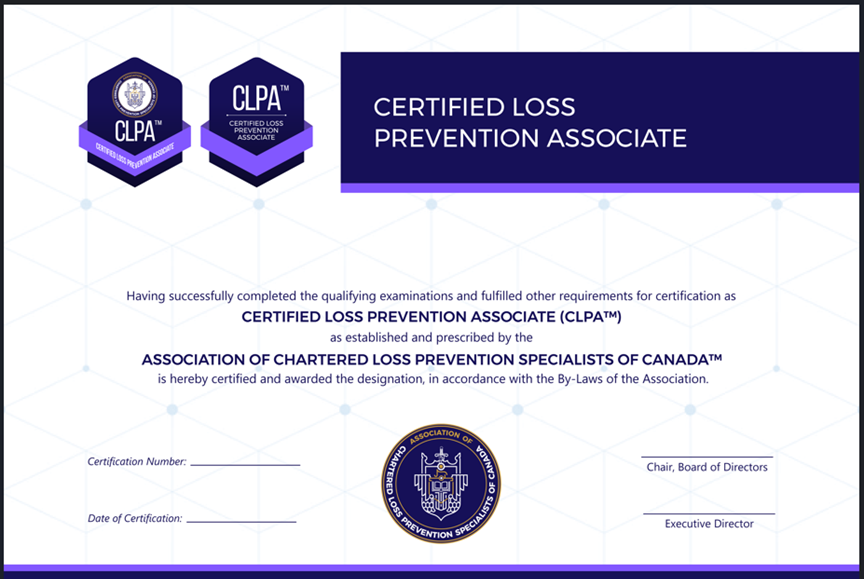
- Certificate of Completion - CLPA